
For global investors evaluating Vietnam investment opportunities 2025, the latest World Bank East Asia and Pacific Economic Update (October 2025) offers a comprehensive view of both promise and pressure points. Vietnam’s growth remains among the fastest in Asia, its reforms are accelerating, and its exports are expanding again despite global turbulence. Yet the same report underscores that soft domestic demand, cautious private credit, and structural bottlenecks require pragmatic navigation.
This article distills the 2025 World Bank findings into a data-grounded view of where Vietnam stands now, what is driving its opportunities, what constraints persist, and how investors can position themselves for long-term success.
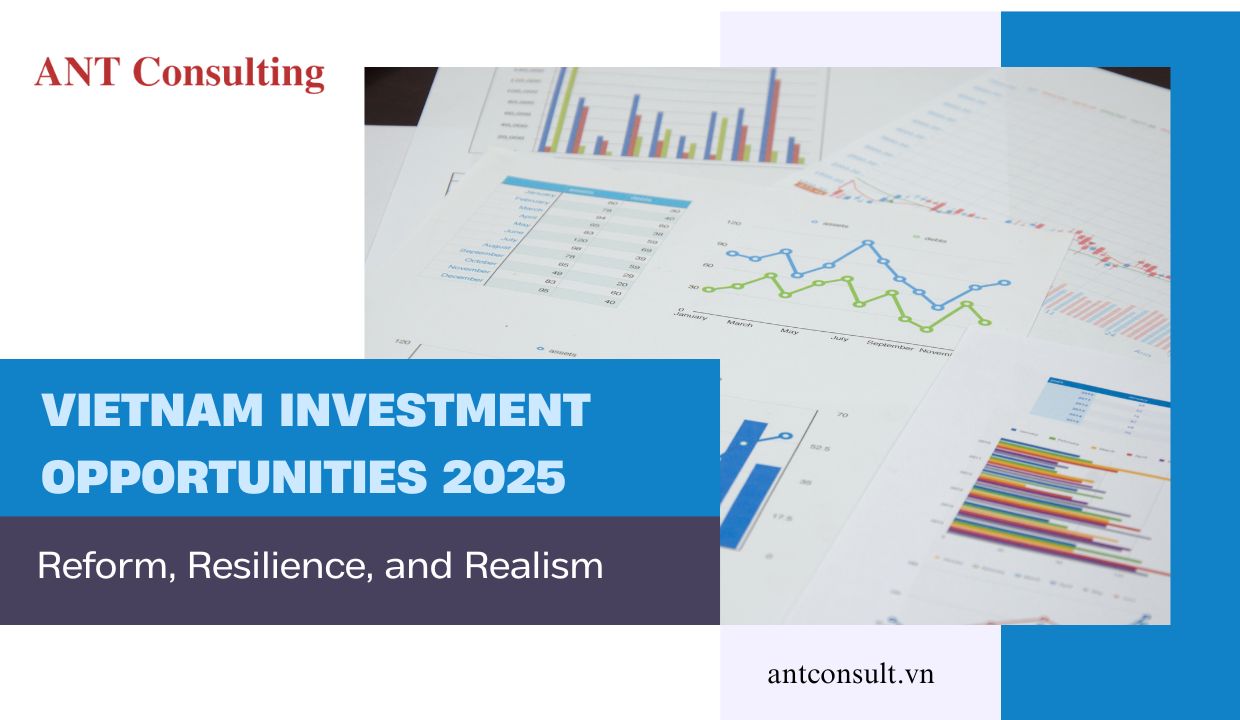
Economic Performance: Strong Growth in a Slowing Region
The World Bank projects Vietnam’s GDP to grow 6.6% in 2025 and 6.1% in 2026, compared with a regional average of 4.4% for developing East Asia and the Pacific. Despite weakening global trade and tariff headwinds, Vietnam’s economy continues to outperform thanks to resilient exports, disciplined fiscal management, and steady FDI inflows.
Per-capita income has increased more than 30% above pre-pandemic levels, signaling broad-based recovery. Exports jumped 14% year-on-year in mid-2025, led by electronics, textiles, and machinery. Inflation is contained below 3%, while public debt remains under 40% of GDP a notable contrast to peers managing rising debt burdens.
For investors, these numbers underscore why Vietnam investment opportunities 2025 remain compelling. Vietnam combines growth speed with macro stability an increasingly rare pairing in emerging markets.
Administrative Reform: Leaner State, Faster Response
Vietnam’s most ambitious reform wave in two decades is transforming its administrative and institutional architecture. The government has:
- Reduced the number of provinces from 63 to 34;
- Abolished district-level administrations;
- Announced a 20% reduction in public employees approximately 100,000 positions over five years.
These measures aim to streamline governance, enhance fiscal efficiency, and cut procedural delays. The World Bank identifies these reforms as a structural shift toward more accountable and responsive governance.
For investors, fewer bureaucratic layers mean faster decision-making, greater regulatory consistency, and lower transaction costs. This ongoing simplification directly improves the business environment and reinforces confidence in Vietnam investment opportunities 2025.
Structural Transition: From Assembly to Innovation
Vietnam’s long-term competitiveness increasingly depends on how quickly it can move from a cost-driven manufacturing model to one rooted in technology and innovation. The World Bank notes significant policy movement in that direction.
Key developments include:
- The Direct Power Purchase Agreement (DPPA) enabling manufacturers to buy renewable electricity directly from producers;
- New incentives for semiconductor design and advanced packaging, alongside public–private partnerships (PPPs) for capital-intensive fabrication;
- Expanded support for digital trade, start-ups, and innovation ecosystems.
The message is clear: Vietnam investment opportunities 2025 lie not only in factories but also in labs, data centers, and clean-energy systems. As technology-intensive manufacturing deepens, Vietnam is positioning itself as a next-generation hub for high-value supply chains.
Trade and Foreign Investment: Integration and Diversification
Vietnam remains one of the world’s most open economies, deeply integrated into global value chains. The World Bank highlights several trends shaping its external sector:
- FDI inflows surged through mid-2025, led by the United States, Japan, China (including Hong Kong), and ASEAN partners;
- Exports outpaced imports, reinforcing external surpluses and foreign exchange stability;
- Active participation in CPTPP, RCEP, and EVFTA continues to anchor diversification and reduce dependence on any single market.
However, the report also points to weak private investment and tight domestic credit, as banks remain cautious following property market stress. For multinational firms, this creates mixed conditions: while external access and trade connectivity remain robust, local liquidity constraints could limit domestic co-investment potential.
Overall, Vietnam continues to be viewed as a regional safe haven for FDI, but sustained competitiveness will require continued financial-sector reform and improved infrastructure execution.
Digital Infrastructure: Broad Reach, Uneven Depth
Digitalization is central to Vietnam’s medium-term development vision. The World Bank notes that:
- Mobile subscriptions exceed 88 per 100 people;
- About 76% of households have fiber broadband;
- Yet, average broadband speeds remain at only 40% of high-income country levels.
This duality strong reach but variable quality defines the digital landscape. It provides a large consumer base for e-commerce, fintech, and cloud services, but also signals areas needing capital investment.
For investors, Vietnam investment opportunities 2025 extend into data centers, cybersecurity, digital logistics, and 5G network development areas where foreign technology and financing can accelerate modernization.
Fiscal Management: Stability with Implementation Challenges
Fiscal performance remains a pillar of Vietnam’s resilience. Debt is contained around 38% of GDP, while the fiscal deficit hovers near 3.2%. The World Bank attributes this to improved revenue collection, controlled inflation, and disciplined spending.
However, public investment disbursement particularly for transportation, green energy, and digital infrastructure lags behind targets. This limits short-term stimulus effects and delays some productivity gains.
For foreign investors, macro stability remains a key strength, but public project execution timelines may require adaptive planning and careful risk assessment in PPP or infrastructure-linked investments.
Labor Market: Youthful Workforce, Emerging Skill Gaps
Vietnam’s labor market remains dynamic but is entering a new phase. Employment has rebounded, wages are competitive, and participation rates are high. Yet the World Bank warns of a growing skills mismatch in high-technology sectors.
While tertiary enrollment has expanded, the share of graduates in STEM fields remains below regional competitors like Malaysia and China. Employers increasingly report shortages of engineers, technicians, and software professionals.
For companies considering Vietnam investment opportunities 2025 in advanced manufacturing or IT, building internal training programs and partnering with universities can bridge this gap and create long-term talent pipelines.
Green Transition: Climate Risk and Clean-Energy Drive
Vietnam’s commitment to net-zero by 2050 is reshaping its investment priorities. The World Bank highlights policy efforts such as the Power Development Plan VIII and renewable energy partnerships, particularly the DPPA framework.
However, the report cautions that grid bottlenecks and financing constraints persist, especially in solar and offshore wind projects. Capacity expansion requires significant investment in transmission networks and project-level risk management.
For green investors, the balance is clear: Vietnam offers a high-potential frontier for sustainable energy, but success demands patient capital and technical collaboration with local authorities to overcome infrastructure limitations.
Key Economic Indicators
|
Indicator |
2025 Projection / Latest Data |
Interpretation |
|
GDP Growth |
6.6% (2025) → 6.1% (2026) |
Strongest in EAP region |
|
Inflation |
<3% |
Stable macro environment |
|
Export Growth |
+14% YoY (mid-2025) |
Rebound in manufacturing |
|
Public Debt / GDP |
≈38% |
Sustainable debt level |
|
Broadband Access |
76% of households |
Solid digital base |
|
Civil Service Cut |
–20% (~100,000 jobs) |
Administrative efficiency |
|
Provinces |
34 (down from 63) |
Streamlined governance |
Each metric reinforces the case for sustained confidence in Vietnam investment opportunities 2025, while reminding investors that institutional reform and execution remain ongoing processes.
Risks and Constraints
Despite optimism, the World Bank identifies several areas requiring close monitoring:
- Global Trade Headwinds: Rising tariffs and policy uncertainty could slow export growth;
- Credit Weakness: Conservative bank lending and unresolved property debt constrain liquidity;
- Climate Exposure: Flooding and extreme weather pose recurring risks to infrastructure and agriculture;
- Administrative Transition Lag: Consolidation of local governments could temporarily disrupt service delivery and coordination.
These are manageable risks, but they require investors to complement optimism with structured risk management and scenario planning.
Policy Directions and Reform Momentum
To sustain momentum, the World Bank recommends Vietnam focus on:
- Accelerating public investment disbursement, especially in energy and transport;
- Deepening financial-sector reform to expand SME credit access and reduce NPLs;
- Enhancing education and vocational systems for digital and green skills;
- Continuing governance modernization to consolidate reform gains.
Each of these policy moves directly strengthens the foundation of Vietnam investment opportunities 2025, improving both business predictability and long-term productivity.
Strategic Outlook for Investors
Vietnam enters 2025 as one of the few economies combining high growth, low inflation, and rapid institutional reform. For multinational companies, it offers an environment where regulatory frameworks are becoming more transparent, infrastructure is expanding, and digital transformation is accelerating.
Yet, as the World Bank underscores, Vietnam’s transition also requires investors to adapt by planning for variable credit access, evolving governance structures, and regional climate resilience.
Those who blend compliance with creativity, and long-term patience with local insight, will find Vietnam’s next decade particularly rewarding.
Conclusion: Vietnam’s Decade of Opportunity
The East Asia and Pacific Economic Update (October 2025) portrays Vietnam as both an outperformer and a reformer. Growth near 6–7%, contained inflation, administrative efficiency, and a green-energy push make it one of Asia’s most investable destinations.
But progress remains uneven financial-sector caution, infrastructure delays, and talent gaps mean results will depend as much on execution as on ambition.
For global investors, the essential insight is that Vietnam investment opportunities 2025 are grounded in real reform, not short-term stimulus. This is a market modernizing from within where resilience meets reinvention, and data supports optimism.
About ANT Consulting in Vietnam
ANT Consulting is here to assist you from the outset; providing intelligence, information, advisory, management or support services that assist market entrance, and ensure efficient business start-up operation.
Corporate Governance & Compliance
For legal advice, consult with ANT Lawyers


How ANT Consulting Could Help Your Business?
You could learn more about ANT Consulting or contact our lawyers and consultants in Vietnam for advice via email ant@antconsult.vn or call our office at +84 28 730 86 529